How the Greenway Is Shaping Boston’s Future
By: Sean Perry

A man riding his bike on the Greenway (Photo by Sean Perry).
Boston struggles with providing easy and sustainable transportation to its residents. The T is slow and frequently out of service, planes are polluting the air in East Boston, and car traffic is an absolute nightmare.
Despite this, 34 years ago, one of the largest and most sustainable urban infrastructure projects in U.S. history was successfully organized and pulled off right here in Boston– the Big Dig, and subsequently, the creation of the Rose-Kennedy Greenway. Now, three and a half decades later, the city is trying to mimic the Greenway’s unprecedented impact by prioritizing green spaces in the Boston 2030 Climate Action Plan.
In 1991, the City of Boston began construction on the "Big Dig" after a decade of planning. They sought out to reroute the elevated Central Artery, a dangerously congested above-ground highway that split Boston, into the underground O’Neil Tunnel. Additionally they planned on constructing the Ted Williams Tunnel in order to extend I-90 to Logan Airport.
At the time, it was one of the most complex and daunting highway projects in the history of the country. It would take a miracle to successfully pull off. Many citizens pegged it as a disaster before construction even began.
The project would create space for more than 45 public parks and plazas, setting the bar for future sustainability efforts in the United States. Most notably, the project resulted in the construction of the Rose-Kennedy Greenway, an organically maintained park set in the heart of Boston that replaced the towering Central Artery. The park, a lively city hotspot, has become a shining example of the power of sustainability projects.


People observe a statue of abolitionist Solomon Northup (Photo Sean Perry).
Boston-based artist Olivia MacDonald said she couldn’t imagine life without the Greenway.
MacDonald has been coming to the Greenway since she was a little girl. Today, it is where she sells her artwork through her business, Ink by Olivia. For her, a favorite childhood spot has continued to support her even into her professional career.
“Even though I mostly come to vend now, sometimes I come for fun to check out the new art installations and the swings,” she explained. “It’s not all business.”
For vendors like MacDonald, the Greenway is a huge source of income for their small businesses. The Artisan Market, which runs May through October, allows vendors to sell anything from jewelry to artwork. MacDonald said it’s a way for them to get their name out there while also profiting off of the Greenway’s foot traffic. Additionally, she enjoys interacting with local Boston residents.
“I think it's a good idea to bring nature into the city more,” she explained. “Make it interactive for the people!”

MacDonald vending for her business, Ink by Olivia (Photo Sean Perry).
The success of the Big Dig has proved just how important it is to invest in green spaces around the city, significantly impacting future city development plans. A key initiative of the Boston 2030 plan is to invest in green spaces. Franklin Park, Boston's largest green space, is a central focus of this plan.
The official Boston 2030 Climate Action Plan plan states that it's a priority to "make sure all neighborhoods have parks, trees, and public infrastructure." Another more comprehensive City of Boston plan, Imagine Boston 2030, cites the cleaning of the Boston Harbor, the construction of the Deer Island Wastewater Treatment Plan, and the creation of the Rose Kennedy Greenway as key examples of how investment in the environmental success of Boston have historically produced citywide success.
Jacob Bor, a member of the Franklin Park Coalition Board, has been a part of the movement to improve Franklin Park since its inception. According to Bor, the process began a few years ago, with the inception of the Franklin Park Action Plan.
The Franklin Park Action Plan, which was created to fulfill the promise of green space expansion made in the Boston 2030 plan, outlines the specific steps the City of Boston will take to develop the park. The plan lists increased levels of management and maintenance, a newfound focus on programming that fosters better physical and mental health, and further collaboration with surrounding communities as some of its main objectives.
Franklin Park is significantly bigger than the Greenway, spanning 527 acres compared to the Greenway's 17. However, the project to improve Franklin Park is not as big of an undertaking as the construction of the Greenway; to construct the Greenway, over a decade of landscaping, building, and demolition had to take place. The Franklin Park Action Plan primarily focuses on remedying current operating issues with the park, such as a lack of programing and maintenance.
While not as big of a venture as the Big Dig, the Franklin Park Action Plan is an important step towards establishing successful green spaces in Boston.
Bor says that Franklin Park usership has significantly increased since the pandemic, resulting in the increased focus on developing the space.
“It's a space that on a hot summer day can be 10 or 15 degrees cooler than the surrounding communities. So both maintaining it and also making sure people can access it has been major priorities for the city,” he said.
Bor said he believes that the development of Franklin Park is only a partial solution to Boston’s greenery issue.
“The woodlands have been neglected for a long time, and we really need work to address some of the issues around the bases,” he said.
One Boston resident, M.J. Schultz, agrees with Bor’s sentiment. She has been coming to the Greenway ever since she moved to Boston nearly seven years ago from the South Shore.
“We need open space. There are a whole variety of ways you could get that, but we need greenery. We don’t have enough,” she said.
For Schultz, the Greenway provides more than just open area– The public art keeps her coming back.
“It’s great that you can put this sort of cultural lore in front of people's minds so they get to think about it. It doesn’t require going to a museum and being all stuffy and traditional. It’s accessible,” she explained.
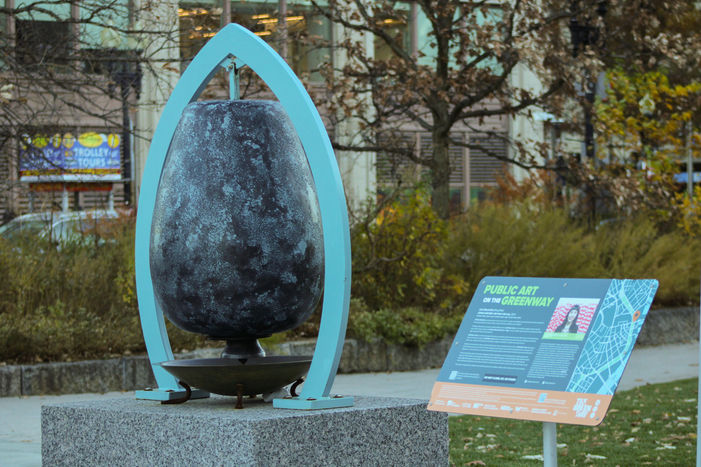
One of the Greenway’s several public art projects (Photo Sean Perry).
It’s natural for a city to struggle with the creation of green space; however, Boston is particularly inorganic, according to a 2019 study done by the telematics company Geotab. Boston’s green space was compared to 14 other major U.S. cities, and the city ended up ranking in the bottom three for amount of green space per resident. Additionally, a more recent study done on Boston’s tree cover by BINJ News revealed that Hyde Park, which has the second-highest green space concentration in the whole city, only has 5.24 trees on the streets per 100 people. The study also revealed that the Back Bay/Beacon Hill area has a quarter an acre of green space or less per 100 people.
Even with large parks like the Boston Common and open spaces like the Greenway, Boston still struggles with greenery. The Big Dig was not an all-encompassing solution to this issue, but rather an invigorating start, setting the stage for developments like the Franklin Park Action Plan.

People walking along the Greenway (Photo Sean Perry).
The Greenway has become a treasured part of Boston. From the art installations, to the beautiful views, to the open area to roam, it shines as an organic haven in the middle of a man-made metropolis. The Big Dig showed that sustainable efforts were obtainable and could significantly improve the quality of life of Boston citizens.
Now, for the 2030 Climate Action Plan, Boston is taking a page from its own book.